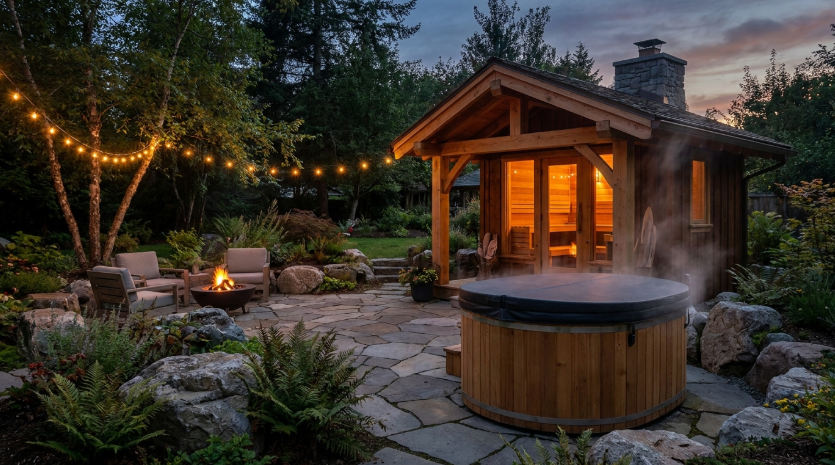
Why Buy Four-Person Capacity When Only Two People Use It Daily?
The instinct to downsize to a 2-person unit because that is the typical headcount is understandable, but it works against daily users in two ways. First, a smaller cabin has less air volume to buffer temperature swings, so the heater cycles on and off more often to hold a steady 170 to 180 degrees, which adds wear over hundreds of sessions a year. Second, two people using a 4-person cabin every night have room to sit apart, stretch out on the lower bench, and avoid the elbow-to-elbow feel that shows up fast in a tight 2-person box. The extra capacity also covers the nights a neighbor or adult child joins in, without forcing anyone to skip the session because the room is full.
How Should the Bench Layout Work for a Two-Person Daily Routine?
An L-shaped bench with two tiers suits daily users better than a single straight bench. The lower tier sits closer to the door and runs 15 to 20 degrees cooler than the upper tier, which is where most people spend a five to ten minute warm-up before moving up. For a couple who uses the cabin every day, having both tiers available means one person can sit low on a night they want a shorter, gentler session while the other takes the upper bench for a longer one. Bench depth matters too: look for at least 20 inches so a person can lie back fully, since daily users tend to value that option more than someone doing occasional short sessions.
See also: SS-31 in 2026: What the Sellers Aren’t Telling You, and Who You Can Actually Trust
What Heater Output Keeps a Daily Cabin Comfortable?
Heater sizing for a 4-person cabin should track cubic footage, not the two-person headcount you expect most nights. A typical 4-person outdoor cabin runs roughly 280 to 340 cubic feet, and the widely used rule of about one kilowatt per 45 to 50 cubic feet puts most models in the 6 to 8 kilowatt range. An undersized heater bought to save money will run continuously trying to reach target temperature and never quite hold it on cold evenings, which is exactly the failure mode daily users notice first. A heater matched to the room’s actual volume reaches 170 degrees in 30 to 40 minutes and then cycles normally rather than running flat out.
What Does a 4-Person Setup Cost to Buy and Run Daily?
Unit and installation costs for a 4-person outdoor cabin typically land between $5,500 and $9,500, with the spread driven mostly by wood species, heater brand, and glass area. Electrical work is usually a separate cost, commonly $400 to $1,200 for a dedicated 240-volt run depending on how far the cabin sits from the panel. Running costs for daily use are modest: a 6 kilowatt heater drawing power for a 45-minute session at a national average electricity rate costs roughly 65 to 75 cents, which works out to under $12 a month even at a session every single day. Buyers comparing options across SweatDecks 4-person saunas and other specialty retailers should weigh heater wattage and wood grade against the sticker price rather than choosing on price alone, since the cheapest 4-person listing is often undersized for its stated capacity.
What Wood and Build Details Matter Most Under Daily Heat Cycling?
Kiln-dried western red cedar and Nordic spruce hold up best under the repeated heating and cooling that daily use puts on a cabin, because both resist warping and checking better than air-dried lumber. Panels joined with tongue-and-groove construction and no exposed metal fasteners on the interior stay cooler to the touch and do not loosen the way screwed panels can after a year of daily cycling. Stove clearances also deserve attention for a heater running this often: keep the manufacturer’s stated clearance to combustible material, usually 3 to 4 inches around the heater guard, and confirm the guard rail itself is rated for continuous daily contact rather than occasional bumping.
What Does the Research Say About Sauna Use This Frequent?
The research base on frequent sauna use comes mostly from Finnish cohort studies, and it is worth being precise about what it shows. A widely cited review in Mayo Clinic Proceedings summarized associations between regular sauna bathing and better cardiovascular markers across multiple studies, without claiming the effect is proven to prevent disease in any one person. A systematic review in Evidence-Based Complementary and Alternative Medicine reached similar conclusions about regular dry sauna bathing and general health markers. An older review in The American Journal of Medicine also outlined both the benefits and the real risks of sauna bathing, including contraindications for people with unstable cardiovascular conditions. None of this is a reason to sauna every day if a doctor has flagged a heart condition, but for healthy adults the association between frequent use and favorable cardiovascular markers is one of the more consistent findings in this body of research.
How Should a Couple Split Cleaning and Upkeep for Daily Use?
A cabin used every single day accumulates sweat, humidity, and general wear faster than one used a couple of times a week, so a light routine matters more than it would for occasional users. Wiping the benches after each session before sweat sets into the wood grain keeps the finish looking new far longer than an occasional deep clean. Cracking a vent or propping the door open for twenty minutes after the last session of the night lets residual humidity escape instead of sitting in the cabin overnight, which is one of the simpler habits that extends a daily-use cabin’s interior life by years rather than months. Splitting this between two people, one handling the wipe-down and the other checking the vent, takes under a minute and prevents the slow buildup that shows up as a musty smell or graying wood after a year of skipped upkeep.
Frequently Asked Questions
Is a 4-person sauna overkill for two daily users? No. A 4-person cabin gives two regular users room to stretch out on the lower bench and lets the heater run without being crowded, which matters more over hundreds of sessions a year than for occasional guests.
What heater size is right for a 4-person cabin used daily? Most 4-person cabins call for 6 to 8 kilowatts, sized to the room’s cubic footage rather than to how many people typically sit down.
How much does a 4-person sauna cost to buy and install? Expect $5,500 to $9,500 for a well-built outdoor cabin including the heater, with electrical work as a separate line item of $400 to $1,200.
Does daily use wear out a sauna faster than occasional use? Wood and heater elements age faster under daily cycling, but a correctly sized heater and kiln-dried wood tolerate daily use well for a decade or more with basic maintenance.
References
- Cardiovascular and Other Health Benefits of Sauna Bathing: A Review of the Evidence, Mayo Clinic Proceedings, 2018
- Clinical Effects of Regular Dry Sauna Bathing: A Systematic Review, Evidence-Based Complementary and Alternative Medicine, 2018
- Benefits and risks of sauna bathing, The American Journal of Medicine, 2001
By Melissa Grant
